quigs.blog

technology

Last month I re-learned something that is obvious to any seasoned photographer: What you already own is usually perfectly good enough. Back in 2016, I bought a Panasonic Lumix GX8 and while I loved its video capabilities, I was consistently disappointed by the photos. Despite owning both a zoom and a prime lens, every image came out frustratingly soft.

The real kicker came with the arrival of the iPhone XR which took sharper photos (although at a lower resolution). I gave up on “real” camera photography for years due to making an amateur mistake of blaming sensor technology for my image quality problems. My assumption was that if my phone's tiny sensor could outperform my dedicated camera, my Panasonic must be outdated. Yet when I started film photography in January, I had a completely different mindset. I knew right away that the lens mattered more than the “sensor” (the film) did. I focused (pun intended) on purchasing the best lenses my budget could afford. For some reason, this fact didn't register for my digital setup until a few weeks ago.

What I failed to realize over four years of using the Panasonic was that gear mattered–but in my case it wasn't the camera body that mattered so much as it was the lens. Sensing my renewed interest in gear, the almighty YouTube algorithm suggested a 2018 review of a Panasonic Leica lens for Micro 4/3 cameras and I was intrigued. Was the cause of my dissatisfaction due to buying budget lenses? Needing the answer, I went to eBay to buy a used Panasonic Leica 15mm (30mm equivalent) and as soon as it arrived I took some test shots.

Wow! This is exactly what I've wanted from this camera since I bought it in 2016! Sure, I've taken some great photos with it but there have been times when I needed to crop or wanted to show some detailed textures and been frustrated with the soft results from the budget lenses.

I'm so grateful to have had the experience of shooting film because it has taught me so much about the basics of photography that digital can often cover up–particularly that new isn't always better–quality is. I never questioned that film photography was all about the lens, yet somehow convinced myself that digital photography was all about the sensor. Sometimes the best upgrade isn't replacing your digital camera with one that has 8 stops of IBIS and more megapixels; just like a good film camera, your old digital body simply requires a lens it deserves.

#technology #photography #reflection #gear

A few months ago, I climbed the volcano Acatenango in Guatemala with four of my best friends. It was a disaster of a trip on so many levels, but thanks to being able to spend quality time with people I love, I had a good time. I did, however, lose my Apple Watch, AirPods, my wallet with my ID and all my credit cards, and some additional camping equipment when I accidentally kicked them off a cliff during the worst tropical rainstorm I've ever seen. It appears that Guatemalan adventures and I are developing an expensive electronics destruction habit.[1]

As soon as I regained internet, I re-ordered and re-purchased replacements for everything I lost, except the Apple Watch. My reasoning at the time was that it was silly to buy a watch in June when new ones were going to come out in September. But as September 9 approaches, I am no longer certain I'll replace my watch at all.

This surprised me because I was an Apple Watch early adopter. I woke up at 5 a.m. to place an order for the very first Series 0 watch in 2015. That piece of crap was barely fast enough to tell the time (let alone any “smart” activities), but at the same time it was absolutely amazing to have a tiny computer on my wrist. I began to rely on the watch as a notification proxy and then quickly as a health-tracking device.

My previous watch (may it rest in pieces under the landslide we narrowly avoided becoming caught in) had cellular capability, allowing me to go without my phone for walks or errands and still stay connected. I even wrote an entire blog post about traveling internationally with just a watch and no phone after my previous Guatemala fiasco.[1:1]

But living without a watch for two months has caused me to have second thoughts about buying a new one.

A cloudy view from the slopes of Acatenango with dead trees sticking up in the foreground.
Great views at 3569m (11,709ft) on almost any day except the one I climbed. 😆

One of the two reasons why I brought the watch on the volcano was to measure my blood oxygen during the high-altitude climb and track the GPS coordinates so that I could animate my climb, matching photos and videos to the position on the volcano on a map. Neither of those features actually worked on the volcano.

Because I was climbing for 5 hours in the rain, the O2 sensor was unable to get a reading. And because I was tracking my heart rate via a workout, I put the watch in battery-saving mode. Unbeknownst to me, that disables the GPS even during workouts, and my watch did not rely on my phone's massive battery to associate GPS coordinates with the workout as I expected. This would be such a simple thing to do—Apple can detect if I'm working out and automatically start tracking it, and yet Apple didn't fall back to my phone's GPS.

Despite the hiccups from using the watch in an extreme environment, I find a lot of value in knowing my O2 levels on a day-to-day basis. However, due to Apple's legal issues with Masimo, the replacement watch I’m considering is unlikely to include the blood oxygen feature I want, and it might not be available until 2028.

As a consumer, I feel irritated that a feature I enjoyed was removed from the watch. I know patent disputes are complicated, but I paid a premium to be taken care of, and the richest company in the world can't seem to work out a solution that benefits me as a consumer here. Apple used to have my back, but now it feels like that’s no longer the case. Given how they have behaved recently with the EU and with the App Store over the last 15 years, I'm hesitant to give them the benefit of the doubt that it's not a “we don't want to lower our margins, so we'll fight it out in court” reason. But I will admit the legal system is most likely to blame here.

Another reason I'm hesitant to buy another watch is that I have noticed that I feel less distracted overall. One benefit of not having notifications on my wrist 22 hours a day[2] is that I miss a lot of notifications. If I do get a replacement watch, I'm going to disable almost all the notifications I can and use the watch primarily as a health device. Sure, the focus modes are great, and you can disable notifications for various apps, but after 9 years of watchOS, I still haven't found a solution I'm happy with.

I am also tired of paying 10-15 US Dollars a month to my carrier for the privilege of having a cellular function that I rarely ever use. I'm not convinced that the monthly cost and the additional $100+ dollars to buy the cellular model is worth the money.

So what are my next steps? After the September 9 announcement I am going to compare the latest Apple Watch to an Oura Ring. Although the Watch appears to be a better fitness tracker in every way, well... quite simply the Oura Ring has a blood oxygen sensor and costs $100 less. Its monthly subscription is half of what my watch's cellular plan, and the Oura doesn't have a screen to distract me.

Apple's strongpoint has always been hardware, and their iOS/iPad/watchOS software would benefit from a lot of quality of life improvements that don't move the stock price the way “AI” does. After all it took Apple 17 years to finally let us arrange our home screen the way we want to.

The watch may be a superior device over other fitness trackers, but I have been going against the grain trying to get Apple's software to behave the way I want it to for 9 years now. I suspect this early adopter and power user might be calling it quits on September 9.


  1. Traveling internationally with only an Apple Watch and no phone ↩︎ ↩︎
  2. I charged my watch twice a day for about an hour at a time after waking up and before bed. ↩︎

#travel #apple #technology #disappointment #fitness

It may seem silly to celebrate the anniversary of my first Mac purchase, which I named Serenity (after the Firefly-class vessel from the TV show by the same name). But it is not silly, because without that machine which I unboxed 18 years ago today, I would not be who I am.

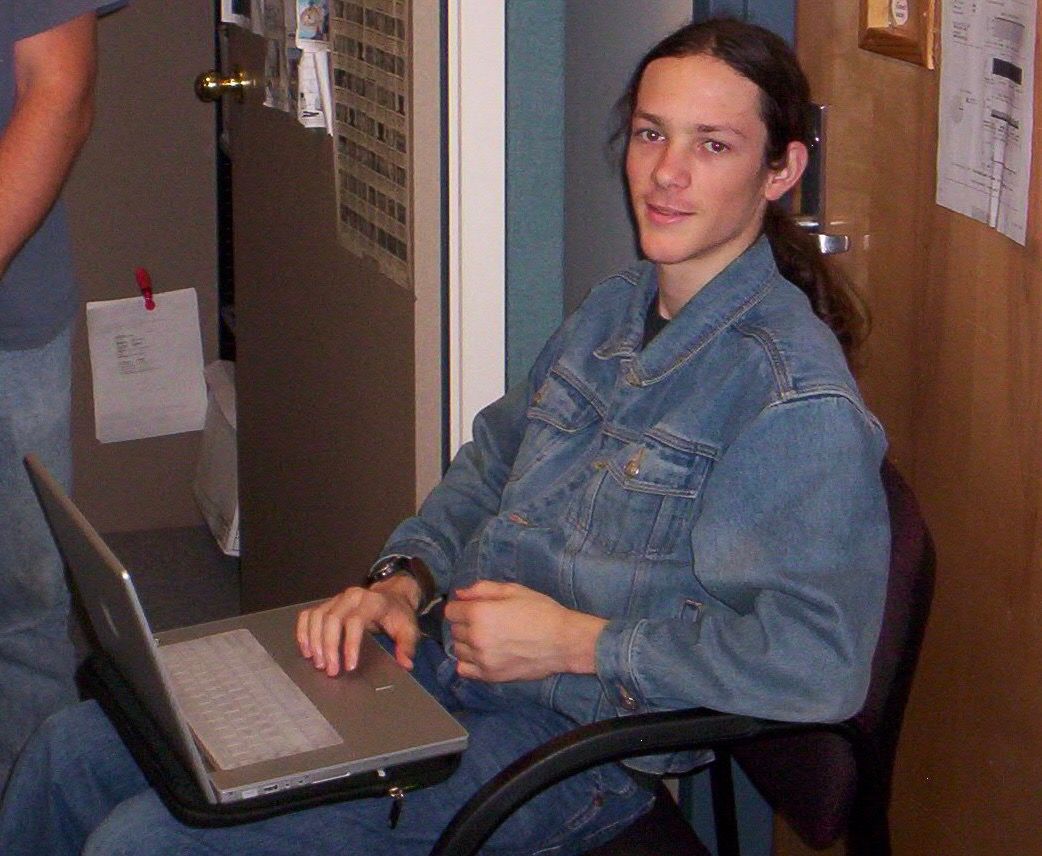
The author as a teen sitting in a chair with the laptop, Serenity, open on his lap.

Without Serenity I would not:

  • Have made a video game in the-then-Mac-only Unity Game Engine with my best friend (the demo was downloaded over 1 million times), which
  • Taught me to code in the Apple ecosystem (foreshadowing), which allowed me to
  • Use that game to impress professors when visiting a specific private University and feel confident that Computer Science was the ideal degree track for me, which
  • Pushed me to attend University to get a Computer Science degree, where I
    • Met my wife at that Univerity,
    • Met lifelong friends (some whom I message with on a daily basis), and which
    • Happened to be the first school in the USA to give out iPhones to all incoming Freshmen, which allowed me to
  • Port the Mac game to iOS to kickstart my iOS development career, which
  • Funded a full semester of private University using my iOS development skills, allowing me to take out fewer loans [1], and
  • Met the USAA recruiters who convinced me to take a “boring” banking job in an exciting nascent iOS development ecosystem before many banks had iPhone apps, where I
  • Built a virtual assistant before AI was a cool buzzword, which
  • Caused me to outgrow the available opporunities at USAA that challenged me, which led me to leave, and
  • Work at Big Nerd Ranch (RIP[2]), famous for their mobile developer consulting skills and educational books that taught many famous developers how to code, where I
    • Learned how to work remotely full time just before the pandemic hit
    • Made lasting friendships with brilliant people
    • Tore apart and re-architected apps for companies like Peloton, Apple, and (ironically), a white-label banking software provider.
    • Learned SwiftUI and other important cutting-edge iOS skills I wasn't getting to practice at USAA
    • Gain leadership experience (both as a tech lead, and as a manager) which,
  • Prompted me to look for Principal Engineering roles, where I
  • Joined a team at Stryker and helped build one of the first Apple Vision Pro apps for the medical industry[3].

Cheers to you, 2006 MacBook Pro with the 2GB ram upgrade. I would not be where I am without you.


  1. Kiplinger Magazine (Archived Link) ↩︎
  2. LinkedIn Page for Big Nerd Ranch (Archived Link) ↩︎
  3. 9-to-5 Mac (Archived Link) ↩︎

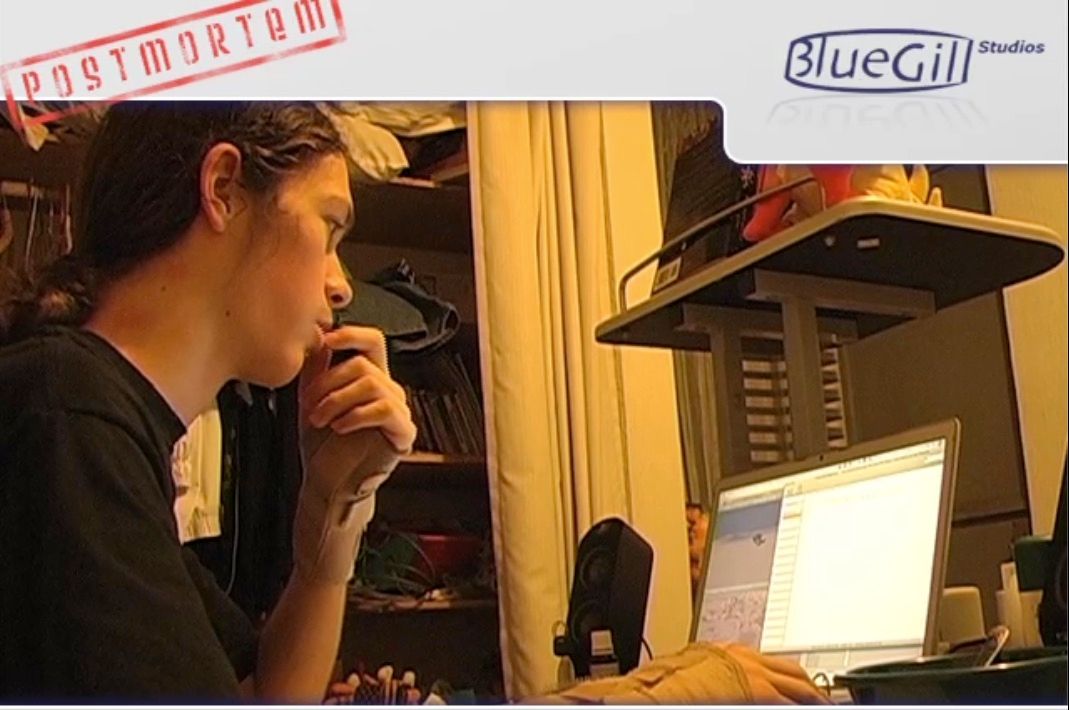
The author staring the the open screen of Serenity, the Mac Book Pro described in this post.

#technology #history #ios #ai #reminiscing #career

In an interview with Russ Roberts on EconTalk, author and futurist Kevin Kelly convincingly suggests that we should treat AIs like Midjourney and ChatGPT as alien intelligences (in a non-spooky way):

I've been using the AI image generators for a year now, every day making AI art and they have different personalities...

But in every case, they're alien—the way that they do things because they're running on a different substrate than, than what we run on.

Their creativity is legitimate. It's really creative, but it's off, it's different than us. It's different, it's alien. They have a slightly different alien way of doing it. And that is, it's true benefit.

That's the main reason why they're valuable is because they're not doing it like humans. When they start to do proofs, they're not gonna do it like a human does it.

If they have/when they have consciousness, it'll be slightly different. It will be akimbo from us because it's running on a whole different thing. It's different latencies in all different ways in which is gonna be different. And that is its benefit.

Video

Listen to the full interview on:
Apple Podcasts
Overcast
Google Podcasts

#technology #ai #artificialintelligence #aliens #podcast #quotes #interview

If you're curious or confused by all the hype about the Twitter-like social network called Mastodon, but all the jargon and tech lingo are giving you cold feet about trying it out, this three-point guide is all you need to get started.

Just like you don't have to be a mechanical engineer to drive your car, you don't need a tech degree to use Mastodon. If you've used email, Facebook groups, or Twitter, you are 1/3 to 3/3 of the way to understanding Mastodon.

It's Similar To Email

Maybe you're alice@aol.com, or bob@gmail, or charlie@yahoo.com. You're that person who signed up for an email account from one company years ago but you don't think twice about sending mail to your friends whose addresses have a different company after the @-symbol than you.

Mastodon works in a similar fashion. Your Mastodon “address” is your @username@server.domain. Mastodon uses an @-symbol in front of the username so that it doesn't get confused with an email address. If @alice@mastodon.social  follows @bob@home.social she will see all of Bob's Mastodon posts just like she would see Bob's emails from bob@gmail.com if he CC'd her on a group email. But remember, Mastodon and email are not the same. If Alice tries to email @bob@home.social from alice@aol.com he won't see her message.

Like email, the first step to getting started on Mastodon is to pick a community  (the text after the second @-symbol). It is also called a server or an instance. The best option is to ask your friends and family if they have a Mastodon and what community server they are on.

Because so many people are interested in Mastodon right now, many Mastodon server computers are overloaded, so if you join a large community and are frustrated by how slow it is, don't give up! Size doesn't matter for finding and following people. Smaller communities are faster for now and the community you join doesn't matter if you are looking to explore Mastodon. You can find servers and communities at  https://mastodon.help/instances/ and sort them by highest or lowest users.

It Works Like A Facebook Group

You've spent the last several years building your circle of friends and family on Facebook. Your timeline feed shows friends sharing memes, grandparents talking about grandkids, and coworkers talking about sports.

But you're also part of a choir Facebook group, or a highschool alumni group. You can post about choir practice and share it with everyone you're Facebook friends with, or you can just share it with the choir group. Mastodon works the same way in that you choose what visibility to assign to your post before you share it.
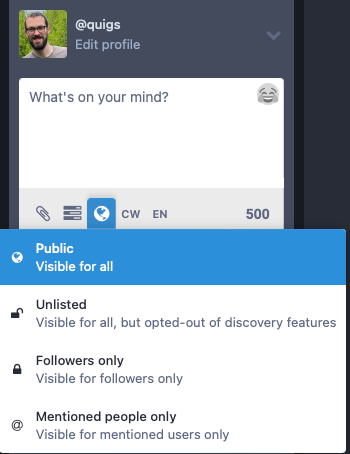
A screenshot with the mastodon post visibility settings displayed.

The different types of visibility options your Mastodon post can have.xx

Unlisted: The visibility setting that is the most like a Facebook Group is “Unlisted”. If you don't want your post to be seen by the entire internet (like the way Twitter works) you can set your post to “Unlisted” before you share it. You can also configure your account to set posts to “Unlisted” by default (or any other visibility setting). When you first sign up all posts are public by default.

Just a warning, though! The only difference between posting on Mastodon and posting to a Facebook Group is that, unlike on Facebook, anyone who follows you can also see your Unlisted posts.

Followers Only: The other Mastodon visibility setting that behaves similar to Facebook is “Followers only”. This is pretty self-explanatory and works like your regular Facebook posts posted to your timeline (not to a group). If you don't want your local Mastodon community/group to see your post, choose “Followers only”.

It's A Lot Like Twitter

Mastodon will feel pretty familiar to you if you're comfortable around Twitter. Like Twitter your Mastodon posts are public to everyone (even those people outside the community or server you joined). Also like Twitter, people can follow you without your approval, or you can lock your accoutn down and review requests to follow you and reject the ones you don't want.

The Twitter algorithm is great at recommending you random things, but if you want to tailor your feed to things that interest you, you're going to have to follow people. When you first launch Mastodon your feed will be empty! That's because you are not following anyone. You can switch the web site, or the app view to display your local community, explore hashtags (and follow them!), or open up to the firehose of all the Mastodon communities (aka the Federation).
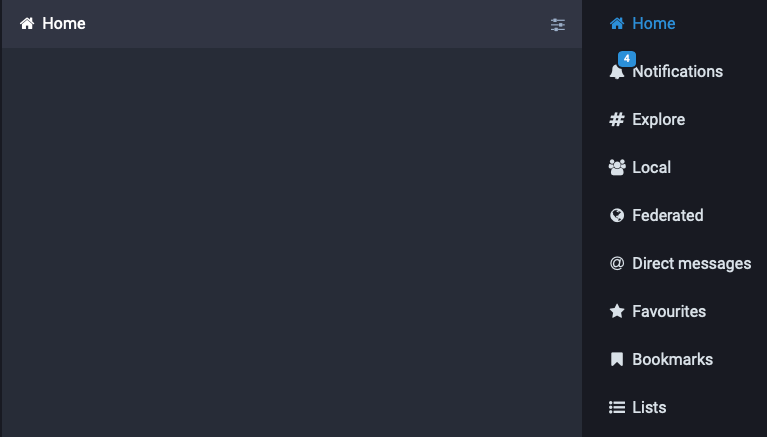
A screenshot of Mastodon with the feed types on the right and an empty home feed on the left.

An empty Home 🙁

Unlike Twitter, there is not algorithm curating your Home feed! The Home feed only shows the stuff the people you are following share (and sometimes the stuff their followers share). Because their is no algorithm, only Boosts (think of them as Retweets) show up in other people's feeds. If you star (favorite) a Mastodon post, only the author will see that—it won't cause the starred post to show up in anyone else's feed or boost engagement.

Also, if you are coming from Twitter and want to find all the people you were following there who are also on Mastodon, check out Debirdify.

Was That Too Confusing?

I'm not going to lie, Mastodon is still quite different from what you're used to and adding followers to your feed can be clunky at times. I often copy and paste the account name (Eg: @user@server) into the Mastodon search field which then gives me a follow icon. But things will get easier. After all people had a hard time getting used to email in the 90s and Facebook in the 2000s and Twitter in the 2010s.
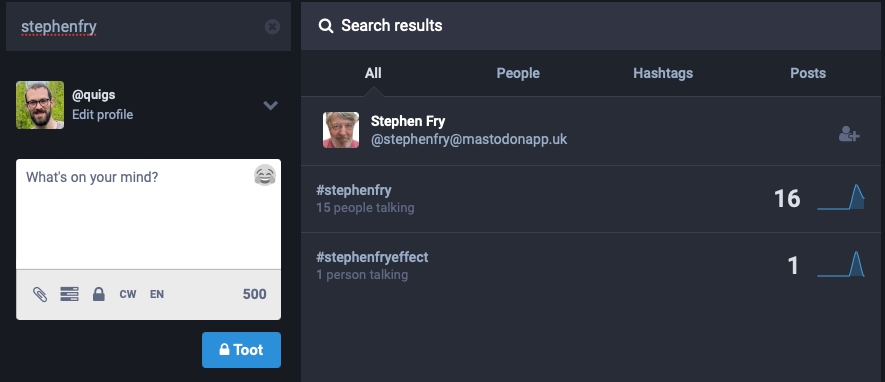
Searching for users also displays a follow button on the right side of the results.

You will figure it out! Go sign up for Mastodon and explore. Give it some time and enjoy the community. I recommend typing #introduction into the search field. That hashtag will display lots of new, interesting Mastodon users introducing themselves and sharing tips.

Once you get some experience under your belt, check out https://mastodon.help for more advanced concepts and settings, and if your feed is empty, follow me at @quigs@hachyderm.io! It won't be empty for long!

#technology #internetculture #howto
Scott Feeney on his blog post, “Four Twitter Features Mastodon Is Better For Not Having” points out several negative aspects of Twitter's design that the Twitter-like Mastodon does not have:

If you’ve gotten in an intense argument on Twitter, you might dread this “So-and-so liked 10 Tweets you’re mentioned in” notification. It tends to mean someone went through and gave kudos to every person arguing with and insulting you. It’s stressful to be pinged over and over with this—which is exactly why we’re all tempted to do this to people we think crossed a line. In doing so, we, again, increase the reach of content we dislike.

The other features he mentions are quite refreshing too.

Also, as of today Mastodon has over 1 million active users! 👀

Eugen 💀 (@Gargron@mastodon.social)

Hey, so, we’ve hit 1,028,362 monthly active users across the network today. 1,124 new Mastodon servers since Oct 27, and 489,003 new users. That’s pretty cool.

#technology #internetculture #crosspromotion #opinion #howto

Every five to ten years, a popular social network gets hit with a crisis. Twitter's current Musk-y crisis feels precipitously different than its previous ones.

Today I came across a thread by John Bull that introduced me to the perfect word to describe 2022 Instagram and Twitter: The trust thermocline. It describes the sudden point in which various individuals lose trust in an an institution or organization en-masse.

I remember the glory days of Digg, Slashdot and MySpace. Suddenly they went from being huge communities with massive network effect to a shadow of a community that I no longer use. Twitter currently feels like it's teetering on that edge.

But they'll only MOVE when they hit the Trust Thermocline. The point where their lack of trust in the product to meet their needs, and the emotional investment they'd made in it, have finally been outweighed by the physical and emotional effort required to abandon it. — John Bull (@garius) November 3, 2022

At several points in the last 6 years I felt that the temperature of several social networks changed suddenly for the worse. In 2016 Facebook was no longer fun and I stopped participating in 2017. In 2019 I stopped following Medium content because it all sounded like self-promotional TED-Talk-Meets-LinkedIn echo chamber of pseudo-intellectual bullshit (on practically any topic).

This year alone I deactivated my Instagram in the summer when I realized it just felt like a confused TikTok of ads overwhelming my friends' posts and videos. Then just this week I re-invested my interest in Mastodon, a decentralized Twitter-like social network born in 2016 that over the last week has gained over 200,000 new users (on top of its several-hundred-thousand existing active accounts).

We shall see what the future holds for Twitter. It still has an enormous amount of momentum due to its size, but it may never be “the” place it was for so many niche communities. Mastodon may not win the lion's share of the Twitter-exodus, but it stands a good chance of becoming somewhat relevant now.

Enjoy the thread and follow John on Mastodon!

One of the things I occasionally get paid to do by companies/execs is to tell them why everything seemed to SUDDENLY go wrong, and subs/readers dropped like a stone. So, with everything going on at Twitter rn, time for a thread about the Trust Thermocline /1 — John Bull (@garius) November 3, 2022

#news #technology #popculture #todayilearned